SaaS Link Building in 2026: A Practical Guide for Startups
What makes a good SaaS backlink, which link building methods work for startups, how to choose anchors, and a simple 90-day plan to get started.

Key takeaways
- SaaS link building means earning backlinks from relevant software, tech and B2B websites.
- Relevance, real traffic and natural placement matter more than any single authority score.
- Mix methods: Digital PR, guest posts, link insertions, expert quotes and linkable assets.
- Keep anchors mostly branded or descriptive. Exact-match anchors at scale are a risk.
- Point links at the pages that make money: product, feature, comparison and use-case pages.
Most SaaS startups don't lose on product. They lose on visibility. A competitor with a weaker tool but a stronger backlink profile will often outrank you for the searches that bring in trial signups, and increasingly, AI search tools will cite them instead of you.
This guide explains how SaaS link building works in practice: what a good link looks like, which methods are worth your time, how to choose anchors, and how to avoid the mistakes that waste budget or put your rankings at risk.
What is SaaS link building?
SaaS link building is the process of earning backlinks for a software company from other websites, ideally ones in the same or a closely related space, such as SaaS blogs, tech publications and B2B industry sites. Each relevant link acts as a vote of confidence. It helps search engines understand what your product does, how trustworthy your site is, and which searches it deserves to rank for.
It differs from general link building in one important way: relevance carries more weight. A link from a respected HR software blog will usually do more for an HR tech startup than a link from a general lifestyle site with a higher authority score.
Why backlinks matter more for SaaS
Software search results are some of the most competitive on the web. A few reasons links matter so much here:
- Crowded keywords. Searches like "best CRM for agencies" or "Slack alternatives" are contested by well-funded companies with years of links behind them.
- High-value traffic. One ranking comparison page can bring in qualified buyers every month, so the value of a top position is high.
- Trust signals for AI search. AI answer engines tend to draw on sources that are widely referenced. Being mentioned and linked across reputable sites makes your brand easier to find and cite.
- Content alone isn't enough. Many startups publish strong content that never ranks, because the site doesn't yet have the authority to compete.
What makes a good SaaS backlink
Not every link is worth having. Before any link goes live, check it against these six criteria.
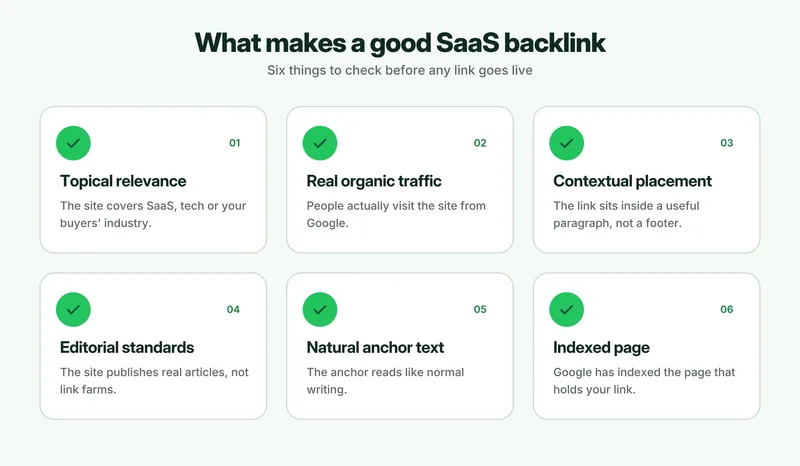
- Topical relevance. The site covers software, technology or your buyers' industry.
- Real organic traffic. People actually find the site through search. A high authority score with no traffic is a warning sign.
- Contextual placement. The link sits inside a paragraph where it helps the reader, not in a footer, sidebar or long list of unrelated links.
- Editorial standards. The site publishes genuine articles with a clear audience, rather than existing only to sell links.
- Natural anchor text. The clickable words read like normal writing.
- An indexed page. Google has indexed the page that holds your link. If it isn't indexed, the link can't help you.
Domain Rating (DR) and similar scores are useful filters, but they're third-party estimates, not Google metrics. Use them to shortlist sites, then judge relevance and traffic yourself.
6 link building methods that work for SaaS
The strongest link profiles come from a mix of methods. Here are the six we see work best for startups.
1. Digital PR
Digital PR means creating stories journalists want to cover: original data, quick reactions to industry news, or expert commentary. When news sites publish the story, they often mention and link to your brand. These links are hard to get, which is exactly why they carry weight. You can see examples on our Digital PR portfolio.
2. Guest posts
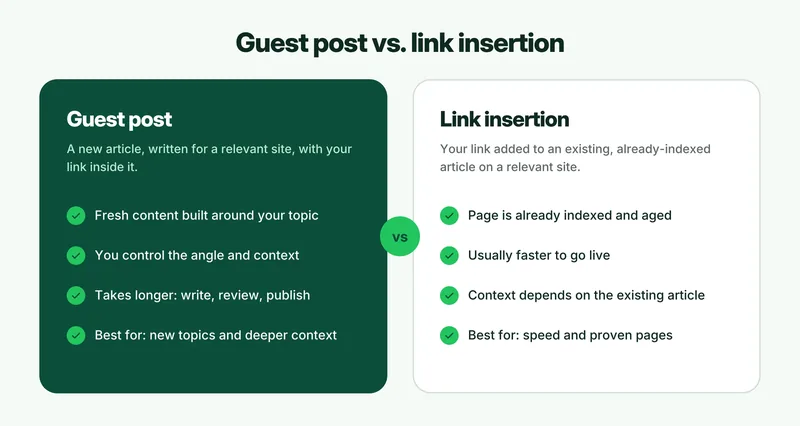
A guest post is a new article you write for another website in your space, with a link back to a relevant page on your site. Done well, it reaches a new audience and earns a contextual link. Done badly, at scale, on irrelevant sites, it becomes a pattern Google can identify. Quality and relevance decide which one you're doing.
3. Link insertions
A link insertion, sometimes called a niche edit, adds your link to an existing article that is already published and indexed. It can be faster than a guest post because the page already exists and may already rank.
4. Expert quotes and contributions
Journalists and bloggers regularly look for expert input. Offering useful, specific quotes from your founders or product team can earn brand mentions and links on respected sites, and it builds your team's personal authority at the same time.
5. Integration and partner pages
If your product integrates with other tools, those partners often have integration directories or marketplace listings. These are some of the most relevant links a SaaS company can get, and they're frequently overlooked.
6. Linkable assets
Free tools, templates, calculators and benchmark reports attract links naturally because they're genuinely useful to reference. A simple "pricing calculator" or "industry benchmarks" page can keep earning links for years.
How to choose anchor text
Anchor text is the clickable text of a link. It tells readers and search engines what the linked page is about. The safest approach is a natural mix that leans on branded and descriptive anchors.
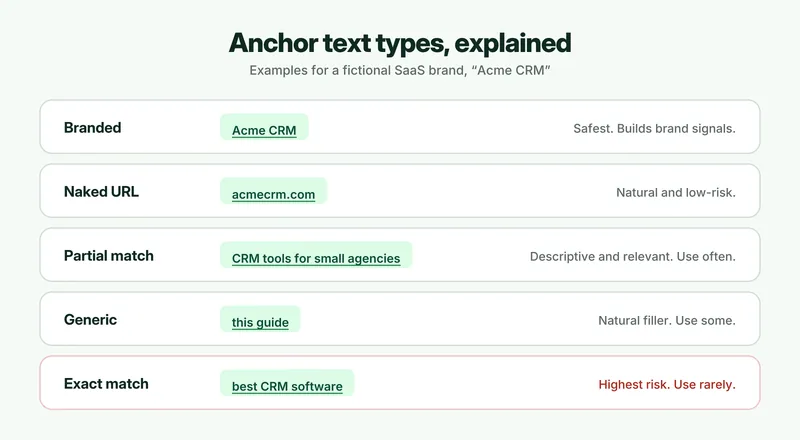
- Branded (e.g. "Acme CRM"): the safest choice and the most natural.
- Naked URL (e.g. "acmecrm.com"): common in real editorial links.
- Partial match (e.g. "CRM tools for small agencies"): descriptive and relevant. Use often.
- Generic (e.g. "this guide"): natural filler in moderation.
- Exact match (e.g. "best CRM software"): the highest risk. Use rarely.
The best anchor is the one that fits both your page and the sentence it sits in. If an anchor feels forced when you read it aloud, change it. Random, repeated keyword anchors can hurt rankings rather than help them.
Which pages should get the links
Many startups point every link at the homepage. That builds brand authority, but it leaves your most valuable pages without support. Spread links across:
- Product and feature pages that target what buyers search for.
- Comparison and alternative pages ("X vs Y", "X alternatives"), which often convert best.
- Use-case and industry pages, such as "CRM for real estate".
- Your best guides, which can then pass authority to product pages through internal links.
Internal linking matters as much as external links. When a guide earns links, link from it to the commercial pages you want to rank.
Staying on Google's good side
Google's spam policies treat links created mainly to manipulate rankings as link spam. Google has also said that links in sponsored and guest posts should carry a rel="sponsored" or rel="nofollow" attribute, and it specifically warns against large-scale guest posting campaigns with keyword-rich anchors.
In practice, that means a few rules matter more than any tactic:
- Put relevance and reader value first. A link should make sense to someone reading the article.
- Avoid large-scale, repetitive campaigns with the same keyword anchors.
- Stay away from private blog networks, sitewide footer links and sites that exist only to sell links.
- Prioritise links that are earned on merit, such as Digital PR coverage, expert quotes and linkable assets.
Any paid placement carries some risk, so the goal is a natural, relevant profile that would look reasonable to a human reviewer.
A simple 90-day SaaS link building plan
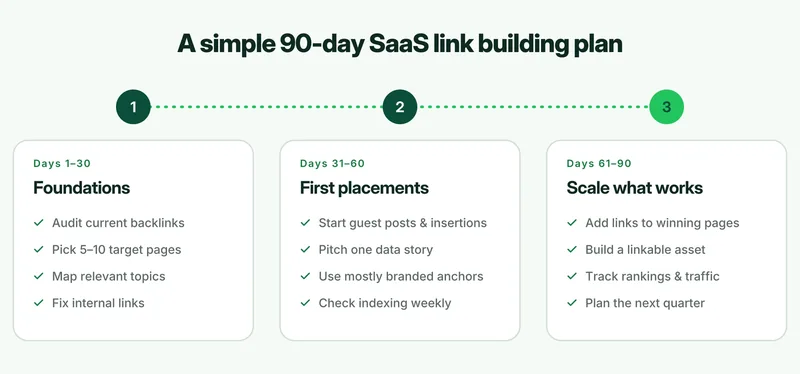
Days 1–30: Foundations. Audit your existing backlinks, pick 5 to 10 target pages, map the topics and sites relevant to your niche, and fix internal links so authority can flow to commercial pages.
Days 31–60: First placements. Start a small number of high-quality guest posts and link insertions on relevant sites, pitch one data-driven story, keep anchors mostly branded, and check indexing as links go live.
Days 61–90: Scale what works. Add links to the pages that are starting to move, build one linkable asset, track results, and plan the next quarter based on what the data shows.
How to measure results
Link building is a slow-compounding channel, so track leading indicators as well as revenue:
- Referring domains from relevant sites, not just total links.
- Rankings for the keywords your target pages are built around.
- Organic traffic to the pages that received links.
- Indexing status of every placement.
- Brand mentions in AI answers, by asking AI search tools about your category and noting whether you're cited.
Most sites see movement over several weeks to a few months, depending on competition and how strong the site already is.
Common mistakes to avoid
- Chasing scores over relevance. A high DR on an unrelated site is worth less than it looks.
- Pointing everything at the homepage. Your product and comparison pages need support too.
- Over-optimised anchors. Repeating the same keyword anchor is one of the clearest spam signals.
- Ignoring indexing. Links on pages Google hasn't indexed do nothing for you.
- Stopping too early. Results compound. A single month of links rarely shows the full effect.
Where to go from here
Start small and stay consistent: a handful of relevant, well-placed links each month will do more than a large batch of weak ones. If you'd rather hand the research and placements to a team that does this every day, see our SaaS link building packages or browse real examples in our SaaS link building portfolio.
Frequently asked questions
How many backlinks does a SaaS startup need?
There's no fixed number. Look at the pages ranking for your target keywords and how many relevant referring domains they have. That's your benchmark. A few strong, relevant links usually beat many weak ones.
How long does SaaS link building take to work?
Most sites see movement over several weeks to a few months. Google needs to crawl and index new links, and results compound as your link profile grows.
Are guest posts still worth it in 2026?
Yes, when they're relevant, genuinely useful and placed on real sites with real readers. Avoid large-scale guest posting with keyword-rich anchors, which Google specifically warns against.
What is a good Domain Rating (DR) for SaaS backlinks?
DR is an Ahrefs estimate, not a Google metric. Use it as a filter, often DR 50 and above for established sites, but judge relevance and real organic traffic before anything else.

Muhammad Abdullah Al Kafy
Founder of Evergreen Outreach and an SEO specialist focused on Digital PR and link building for startups and SaaS brands. Running campaigns since January 2024.